How to Apply for a NADRA Death Certificate in Pakistan 2026–2027
Apply for a NADRA Death Certificate in Pakistan 2026–2027
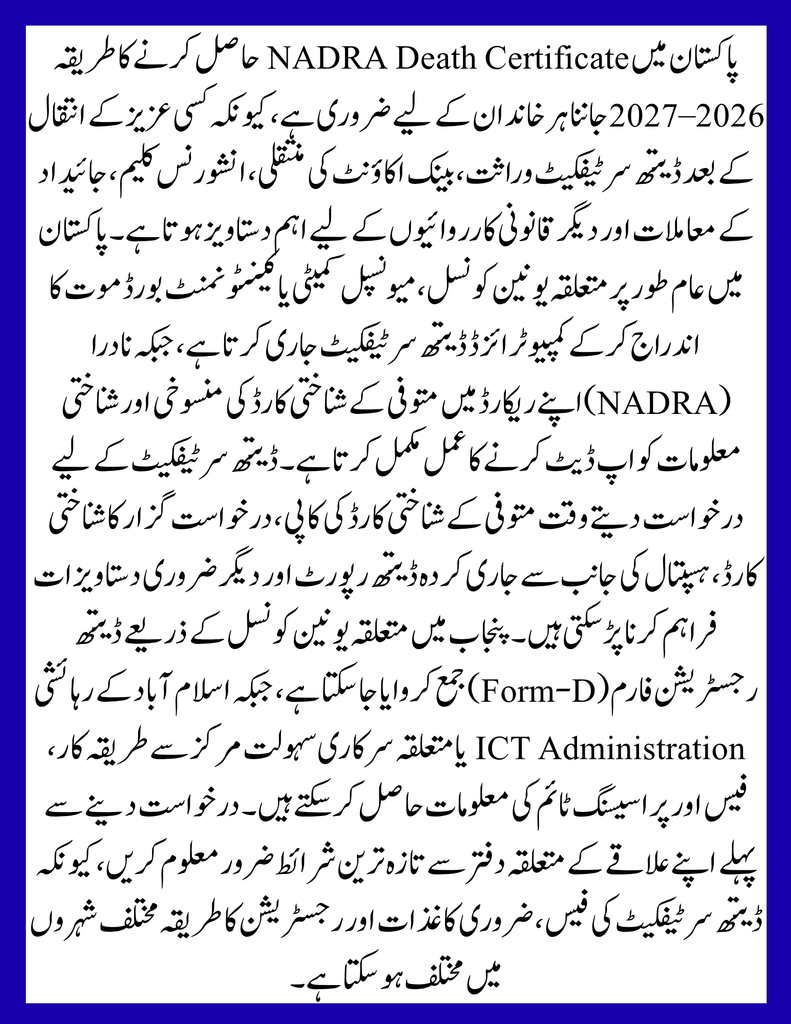
When a family member passes away, registering the death is an important legal responsibility. A death certificate is required for several official matters, including inheritance claims, bank accounts, insurance payments, property transfers and other legal procedures. In Pakistan, people commonly search for a NADRA Death Certificate because they need an official computerized record of a deceased family member.
However, the process involves more than simply visiting a NADRA office. The relevant Union Council, Municipal Committee, Cantonment Board or Capital Development Authority (CDA) generally handles the original death registration, depending on the area where the person lived or died. NADRA updates its national identity records and processes the cancellation of the deceased person’s CNIC after the required registration.
In this guide, you will learn how to apply for a NADRA Death Certificate in Pakistan, which documents are required, where to submit an application, how computerized death registration works, and what families should know about online services, late registration and document attestation in 2026–2027.
More Read: Provincial Codes for Petrol Relief Scheme 2026
What Is a NADRA Death Certificate in Pakistan?
A NADRA Death Certificate is the commonly used name for an official computerized death registration record in Pakistan. It provides legal evidence that a person has passed away and records important information about the deceased.
The document generally contains the deceased person’s name, date of death, place of death and other identifying details. It is used by government departments, banks, insurance companies, courts and other organizations when they need proof of a person’s death.
It is important to understand the difference between death registration and CNIC cancellation. Death registration is normally completed through the relevant local government authority, while NADRA updates the deceased person’s identity record.
A Computerized Death Certificate is particularly important when family members need to settle financial or legal matters after someone’s death.
NADRA Death Certificate Pakistan – Informational Table (2026–2027)
| Information | Details |
|---|---|
| Certificate Name | Computerized Death Registration Certificate |
| Common Name | NADRA Death Certificate |
| Issuing Authority | Union Council / Municipal Committee / Cantonment Board / CDA |
| NADRA’s Role | Updating identity records and CNIC cancellation |
| Application Method | Offline or online, depending on local authority |
| Application Form | Death Registration Form (Form-D in Punjab guidance) |
| Required Documents | Deceased person’s CNIC, applicant’s CNIC, death proof and supporting documents |
| Hospital Death Proof | Hospital death certificate or medical report, where applicable |
| Burial Proof | Graveyard slip or burial receipt, where required |
| Application Verification | Verification by the relevant registration authority |
| Registration Fee | Depends on location and applicable rules |
| Punjab Published Fee | Rs. 200 within 60 days (e-Khidmat published information) |
| Punjab Processing Time | 7 working days (published service information) |
| Islamabad Processing Time | 7 days (ICT Administration published information) |
| Late Death Registration | Additional verification or court procedure may apply |
| CNIC Cancellation | Processed separately through NADRA |
| MOFA Attestation | Available subject to document requirements |
| Apostille Service | Available through the official MOFA Apostille system |
| Main Uses | Inheritance, insurance claims, banking, property and legal matters |
| Overseas Use | May require MOFA attestation or apostille |
| Registration Year | 2026–2027 |
Which Department Issues a Death Certificate in Pakistan?
The department responsible for issuing a Death Certificate in Pakistan depends on the location and applicable local government rules.
In most areas, the concerned Union Council or Municipal Committee issues the Computerized Death Registration Certificate. In Islamabad, the Capital Development Authority or the relevant designated authority handles death registration services. Cantonment areas have their own registration arrangements.
The Punjab Local Government and Community Development Department confirms that the relevant Union Council or Municipal Committee issues the computerized certificate. It also identifies Form-D under the UC/MC Birth and Death Registration Model Bye-Laws 2016 as the relevant death registration form.
NADRA’s role is different because it maintains national identity records based on registered information.
Difference Between Union Council and NADRA Death Registration
| Department | Main Responsibility |
|---|---|
| Union Council | Registers the death and issues the computerized certificate |
| Municipal Committee | Handles death registration in its jurisdiction |
| Cantonment Board | Provides death registration services in cantonment areas |
| CDA Islamabad | Handles relevant civil registration services in Islamabad |
| NADRA | Updates identity records and processes CNIC cancellation |
| Ministry of Foreign Affairs | Provides document attestation and apostille services |
How to Apply for a NADRA Death Certificate in Pakistan
If you want to apply for a death certificate, you should first identify the local government office responsible for the deceased person’s area. The following steps explain the general Death Certificate Registration process.
Step 1: Visit the Relevant Union Council
Visit the Union Council or Municipal Committee responsible for the area where the death occurred or where the death must be registered under local rules.
Ask the registration staff for the prescribed Death Certificate Application Form. In Punjab, Form-D is identified in the official local government guidance for death registration.
If the death occurred in a cantonment area, contact the relevant Cantonment Board instead of assuming that the ordinary Union Council will handle your application.
Step 2: Collect the Required Documents
Before submitting your application, prepare the available documents relating to the deceased person.
These may include:
- Copy of the deceased person’s CNIC.
- Original hospital death certificate or medical report.
- Copy of the applicant’s CNIC.
- Burial or graveyard receipt, where applicable.
- Information about the deceased person’s father, mother or spouse.
- Proof of residence, if requested.
- Prescribed application form.
- Additional supporting documents requested by the registration authority.
The exact requirements can vary depending on the circumstances of the death and the local registration rules.
Step 3: Complete the Death Certificate Application Form
Fill out the Death Certificate Application Form carefully. Make sure that the deceased person’s name, CNIC number, date of death and other personal details match the available official records.
Incorrect information can create problems during registration and may also affect future legal matters.
The applicant should provide their own contact details and relationship with the deceased person. Submit the completed form with the required supporting documents to the relevant registration office.
Step 4: Verification of Death Information
After receiving the application, the concerned authority may verify the information and supporting evidence.
For example, a hospital-issued death certificate can serve as proof of death. If someone dies at home, the authority may require affidavits from close relatives or neighbours. In areas with an established cemetery registration system, a cemetery receipt may also be accepted.
The verification requirements depend on the circumstances and local authority.
Step 5: Pay the Applicable Fee
The registration office will inform you about the applicable certificate issuance fee and any additional charges.
Keep the payment receipt because it may be needed when collecting the document or checking the application status.
Step 6: Collect the Computerized Death Certificate
Once the application is approved, the relevant authority issues the Computerized Death Registration Certificate.
Check the spelling of the deceased person’s name, CNIC number, date of death and other information before leaving the office.
If you find an error, request correction through the issuing authority rather than using an incorrect certificate for legal purposes.
Step 7: Visit NADRA for CNIC Cancellation
After completing the death registration, the family should also inform NADRA and follow the CNIC cancellation procedure.
The cancellation of a deceased person’s identity card is a separate but important step. Keep the cancellation record or certificate because it may be required for subsequent official procedures, including certain Ministry of Foreign Affairs attestation applications.
NADRA Death Certificate Requirements in 2026–2027
The documents required for death registration can differ according to the place and circumstances of death. However, applicants should prepare the following documents before visiting the concerned office.
| Required Document | Purpose |
|---|---|
| Deceased person’s CNIC copy | Identification of the deceased |
| Applicant’s CNIC copy | Identification of the person submitting the application |
| Hospital Death Certificate | Evidence of death in hospital cases |
| Medical Report | Supporting evidence, where required |
| Graveyard Slip | Burial confirmation, where applicable |
| Death Registration Form | Official application for registration |
| Family Information | Verification of family details |
| Affidavit | May be required for deaths occurring at home |
| Additional Evidence | Documents requested by the relevant authority |
Is a Hospital Death Certificate Necessary?
A Hospital Death Certificate is useful evidence when a person passes away in a hospital, clinic or other medical facility.
The document normally confirms the person’s identity and details about the death. However, a hospital report and a computerized civil death registration certificate are not necessarily the same document.
A hospital certificate is generally submitted as supporting evidence to the relevant local government office.
Is a Graveyard Slip Required?
A Graveyard Slip or burial receipt can help confirm that the deceased person was buried in a particular cemetery.
Punjab government guidance specifically mentions documentary evidence, including a certificate or receipt issued by the graveyard caretaker (Ghorkan), as supporting evidence for computerized death registration.
However, the requirement may differ between local authorities.
NADRA Death Certificate Online – Can You Apply Through the Internet?
Many people search for NADRA Death Certificate Online because they want to complete the entire application process from home.
However, applicants should understand that there is no single nationwide online death registration procedure that replaces every Union Council, Municipal Committee or Cantonment Board.
The availability of online services depends on the relevant local authority and the facilities offered in that area.
Before applying online, check whether your local government provides:
- Online death registration.
- Downloadable application forms.
- Online document submission.
- Application tracking.
- Online certificate delivery or collection information.
If these services are not available, you may need to visit the relevant registration office with the original documents.
Important: Do not assume that every website advertising online NADRA Death Certificate services is an official government portal. Use the relevant government website or visit the registration office to confirm the available service.
Death Certificate Application Form – Where Can You Get It?
The Death Certificate Application Form is available through the relevant local registration authority.
In Punjab, the official government guidance identifies Form-D of the Union Council and Municipal Committee Birth/Death Registration Model Bye-Laws 2016 for death registration.
Islamabad applicants should check the CDA or ICT Administration website for the relevant form and instructions.
The application form generally requests the following information:
- Full name of the deceased person.
- CNIC number, where available.
- Father’s, mother’s or spouse’s name.
- Residential address.
- Date and place of death.
- Age and other identifying details.
- Applicant’s name and relationship with the deceased.
- Contact information and application date.
Always use the form prescribed by the relevant authority because different jurisdictions may follow different application arrangements.
Death Certificate Fee and Processing Time in Pakistan
The Death Certificate fee is not necessarily the same throughout Pakistan. Local governments may have different fee schedules, processing times and late-registration procedures.
For example, the Punjab e-Khidmat Markaz service information lists a certificate issuance fee of Rs. 200 for registration within 60 days and a delivery time of seven working days. This is a published Punjab service detail and should not be treated as a nationwide fee.
The Islamabad ICT Administration website lists a processing time of seven days and a fee range of Rs. 200 to Rs. 1,500, depending on the age of the child. Applicants should confirm the applicable category and current charges directly with the office.
Death Certificate Fees and Processing Details
| Location / Service | Published Fee | Processing Time |
|---|---|---|
| Punjab e-Khidmat Markaz | Rs. 200 within 60 days | 7 working days |
| Islamabad ICT Administration | Rs. 200–1,500, depending on age category | 7 days |
| Other Union Councils | Varies by local authority | Confirm locally |
| Cantonment Boards | According to relevant board rules | Confirm locally |
These are published service details, not a universal 2026–2027 fee schedule. Always confirm the latest fee before submitting your application.
Late Death Registration in Pakistan
Sometimes families do not register a death immediately because they are unaware of the procedure, live abroad or have difficulty collecting the required documents.
In such situations, late registration may be possible, but the procedure can be different from normal registration.
For example, Punjab’s e-Khidmat service guidance states that applications for registration after 60 days are subject to a court-related procedure. Other local authorities may have different requirements.
If the death occurred several months or years ago, contact the relevant Union Council or Municipal Committee before preparing your application.
You may be asked to provide additional evidence, affidavits, hospital records, burial information or court documents, depending on the case.
Death Certificate Registration in Major Cities of Pakistan
The general death registration process is similar across many Pakistani cities, but the responsible office, fee and documentary requirements may differ.
Death Certificate Karachi
Residents of Karachi should contact the relevant Union Council, Municipal Committee or other competent local authority for death registration. Cantonment areas may have separate arrangements.
Death Certificate Lahore
Applicants in Lahore can contact their relevant Union Council or Municipal Committee. Punjab’s e-Khidmat Markaz also provides death certificate services according to its published service instructions.
Death Certificate Islamabad
In Islamabad, applicants can use the relevant CDA or ICT Administration services. The ICT Administration lists the Citizen Facilitation Center in Mauve Area, G-11/4, as its death registration application location.
Death Certificate Rawalpindi
Residents should contact the relevant local registration office in Rawalpindi. The correct authority depends on the deceased person’s area and whether it falls within a cantonment jurisdiction.
Death Certificate Hyderabad
Applicants in Hyderabad should approach the relevant Union Council or Municipal Committee and confirm the local application requirements.
Death Certificate Peshawar
Residents of Peshawar should contact their relevant local government registration office to confirm the required documents and applicable fee.
Death Certificate Faisalabad
The Faisalabad district government confirms that the relevant Union Council or Municipal Committee issues the Computerized Death Registration Certificate. Its guidance also mentions graveyard documentation as supporting evidence.
Death Certificate for Overseas Pakistanis
Overseas Pakistanis may need a Pakistani death certificate when a family member passes away in Pakistan or when they need to complete legal procedures in another country.
For example, a person living abroad may require a death certificate to settle inheritance matters, close a deceased person’s bank account, process an insurance claim or submit documents to a foreign government department.
If the applicant cannot visit Pakistan personally, they should contact the relevant registration authority to ask about representation through a family member or authorized person.
The authority may request an authorization letter, identification documents or other supporting evidence.
A Death Certificate for Overseas Pakistanis may also need attestation before it can be accepted by a foreign institution.
Death Certificate Attestation and MOFA Requirements
A Pakistani death certificate may require attestation when it is being submitted to a foreign government department, embassy, court or other institution.
The Ministry of Foreign Affairs (MOFA) includes death certificates in its list of personal documents eligible for attestation.
According to the Ministry’s published instructions, death certificates of Pakistani nationals should have the deceased person’s CNIC cancellation certificate issued by NADRA.
MOFA Death Certificate Attestation Procedure
The general process involves the following steps:
- Obtain the original death registration certificate from the relevant issuing authority.
- Complete the required NADRA CNIC cancellation process.
- Check the Ministry of Foreign Affairs document requirements.
- Create an account on the official MOFA Apostille portal.
- Submit the application and upload the required documents.
- Wait for application approval and further instructions.
- Visit the relevant office on the scheduled appointment date, if required.
A Ministry of Foreign Affairs notice states that online registration has been mandatory for apostille applications from 27 July 2026 onwards. Applicants should use the official portal and check the latest appointment and document requirements before visiting.
Official portal: https://apostille.mofa.gov.pk/
Apostille Death Certificate Pakistan
An Apostille Death Certificate Pakistan is a death certificate that has completed the relevant apostille authentication process for use in countries that accept apostilles.
However, the receiving country’s requirements should always be checked before applying. Some foreign institutions may request additional documents or translations.
MOFA attestation and apostille services should not be confused with the original death registration process.
Why Do Families Need a Death Certificate?
A death certificate is not only a record of someone’s death. It is also an important document for completing several legal and financial responsibilities.
Death Certificate for Inheritance
Family members may need a death certificate when dealing with inherited property, bank accounts and other assets.
It can be used as supporting evidence when applying for a succession certificate or completing other legal inheritance procedures.
Death Certificate for Visa
A foreign embassy or immigration department may request a death certificate when someone applies for a visa on compassionate grounds, submits family-related documents or explains a change in family circumstances.
The exact requirements depend on the country and visa category.
Death Certificate for Insurance Claim
Insurance companies may request an official death certificate before processing a life insurance claim.
The applicant may also need the policy document, identification records and other supporting paperwork.
Death Certificate for Succession Certificate
A Succession Certificate in Pakistan is a separate legal document from a death certificate.
The death certificate provides evidence of death, while the succession certificate is used in relevant legal proceedings involving the deceased person’s movable assets.
Death Certificate for Property Matters
The legal heirs may need the death certificate when handling property transfers, ownership records or inheritance-related proceedings.
The issuing authority or relevant court may request additional legal documents.
Death Certificate for Court
Courts may require a death certificate as evidence in inheritance disputes, property cases, family matters and other legal proceedings.
Death Certificate for Burial
A death certificate or related death registration record may also be required for official burial records and other administrative matters.
Legal Heirs Death Certificate – What Should Families Know?
People sometimes search for a Legal Heirs Death Certificate when they need to settle the affairs of a deceased family member.
However, a death certificate and a legal heirs certificate are not the same thing.
A death certificate confirms the death of a person. Documents establishing legal heirs or succession rights are obtained through the applicable legal process.
Family members should first complete death registration and then contact the relevant legal authority for inheritance or succession matters.
Death Certificate Verification and Reference Number
After receiving a computerized death registration certificate, applicants should check all the information printed on it.
The Death Certificate Reference Number or registration number can help identify the registered record when communicating with the issuing authority.
If you need Death Certificate Verification, contact the office that issued the certificate or use its official verification facility, if available.
Do not rely on an unofficial website or an unverified reference number to confirm the authenticity of a legal document.
Other NADRA and Civil Registration Certificates in Pakistan
People searching for NADRA Certificate Services Pakistan may also need other official civil registration documents.
These certificates serve different purposes and should not be confused with a death certificate.
| Certificate | Main Purpose |
|---|---|
| NADRA Birth Certificate | Official record of birth |
| NADRA Marriage Certificate | Computerized record of marriage |
| Divorce Certificate | Official record of divorce |
| Succession Certificate in Pakistan | Legal document relating to succession to movable assets |
| Unmarried Certificate in Pakistan | Document used to confirm unmarried status for specific official purposes |
The relevant issuing authority and application requirements depend on the type of certificate.
For example, a NADRA Birth Certificate relates to birth registration, while a NADRA Marriage Certificate relates to marriage registration. Similarly, a Divorce Certificate and an Unmarried Certificate are separate documents with their own legal and administrative requirements.
Important Notes Before Applying for a Death Certificate
Before submitting your application, keep these important points in mind:
- The Union Council or relevant local government authority generally handles the original death registration.
- NADRA’s role includes updating identity records and cancelling the deceased person’s CNIC.
- A hospital death report and a computerized death registration certificate are different documents.
- The required documents can vary according to the place and circumstances of death.
- Late registration may involve additional verification or a court procedure.
- Online registration is not available through one universal nationwide portal.
- Certificate fees and processing times differ between local authorities.
- CNIC cancellation may be required before MOFA attestation of a Pakistani national’s death certificate.
- Always obtain information from the relevant government office before paying any fee.
Frequently Asked Questions (FAQs)
1. How can I apply for a NADRA Death Certificate in Pakistan?
Visit the relevant Union Council, Municipal Committee or other competent local registration authority. Submit the prescribed application form with the required documents, complete verification and collect the computerized death registration certificate.
2. Can I apply for a NADRA Death Certificate online?
Online facilities depend on the relevant local government authority. Some areas offer digital services or downloadable forms, but there is no single nationwide online process that replaces every local registration office.
3. Who issues a computerized death certificate in Pakistan?
The relevant Union Council or Municipal Committee generally issues the Computerized Death Registration Certificate. Cantonment Boards and CDA Islamabad handle registration in their respective jurisdictions.
4. What documents are required for death registration?
Common documents include the deceased person’s CNIC copy, applicant’s CNIC, hospital death report, burial receipt where applicable and the prescribed death registration form. Additional evidence may be required.
5. What is the fee for a death certificate in Pakistan?
The fee depends on the location and applicable local government rules. For example, Punjab e-Khidmat lists Rs. 200 for issuance within 60 days, while Islamabad ICT Administration publishes a different fee range.
6. Can I get a death certificate if the person died several years ago?
Late registration may be possible, but additional evidence and verification can be required. In Punjab, the published e-Khidmat guidance directs cases after 60 days through a court-related procedure.
7. Is a hospital death certificate enough for legal purposes?
A hospital death report can be accepted as proof of death for civil registration, but it is not necessarily a replacement for the computerized death registration certificate.
8. Is NADRA CNIC cancellation necessary after death registration?
Families should complete the CNIC cancellation process through NADRA. This updates the national identity record and may also be necessary for other official procedures.
9. Can overseas Pakistanis apply for a death certificate?
Overseas Pakistanis should contact the relevant local registration authority to confirm whether a family member or authorized representative can submit the application on their behalf.
10. Can I use a Pakistani death certificate abroad?
Yes, subject to the receiving country’s requirements. MOFA attestation or apostille authentication and additional supporting documents may be required.
Conclusion
Applying for a NADRA Death Certificate in Pakistan is an important step when a family member passes away. The first responsibility is to register the death with the relevant Union Council, Municipal Committee, Cantonment Board or CDA, depending on the location.
After receiving the Computerized Death Registration Certificate, family members should complete the NADRA CNIC cancellation process and keep the relevant records safe for future legal and financial matters.
In 2026–2027, applicants should always check the latest instructions, fees, required documents and online facilities through their relevant government authority because death registration procedures are not identical across all areas of Pakistan. Using official information can help families avoid unnecessary delays and complete the process correctly.
Official Sources for NADRA Death Certificate in Pakistan
| Source | Verified Information | Official / Reference Link |
|---|---|---|
| NADRA Clarification (ProPakistani) | Union Councils register deaths, while NADRA updates identity records. | ProPakistani – NADRA Death Certificate Clarification (2025) |
| Punjab Local Government (LGCD) | Explains the death registration authority, Form-D and required supporting documents. | Punjab LGCD – Official FAQs |
| ICT Administration | Provides Islamabad death registration procedures, applicable fees and processing time. | ICT Administration – Death Registration |