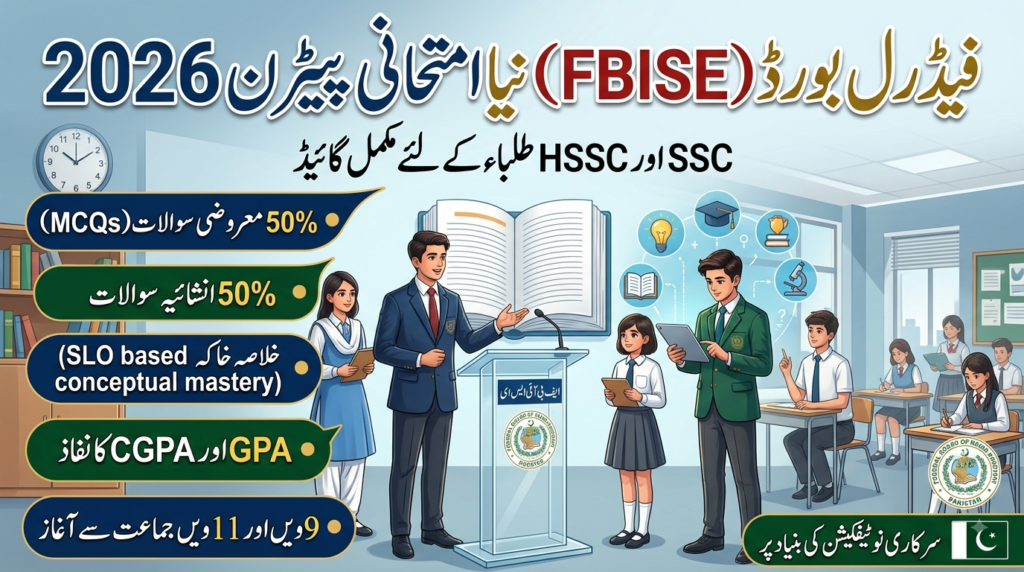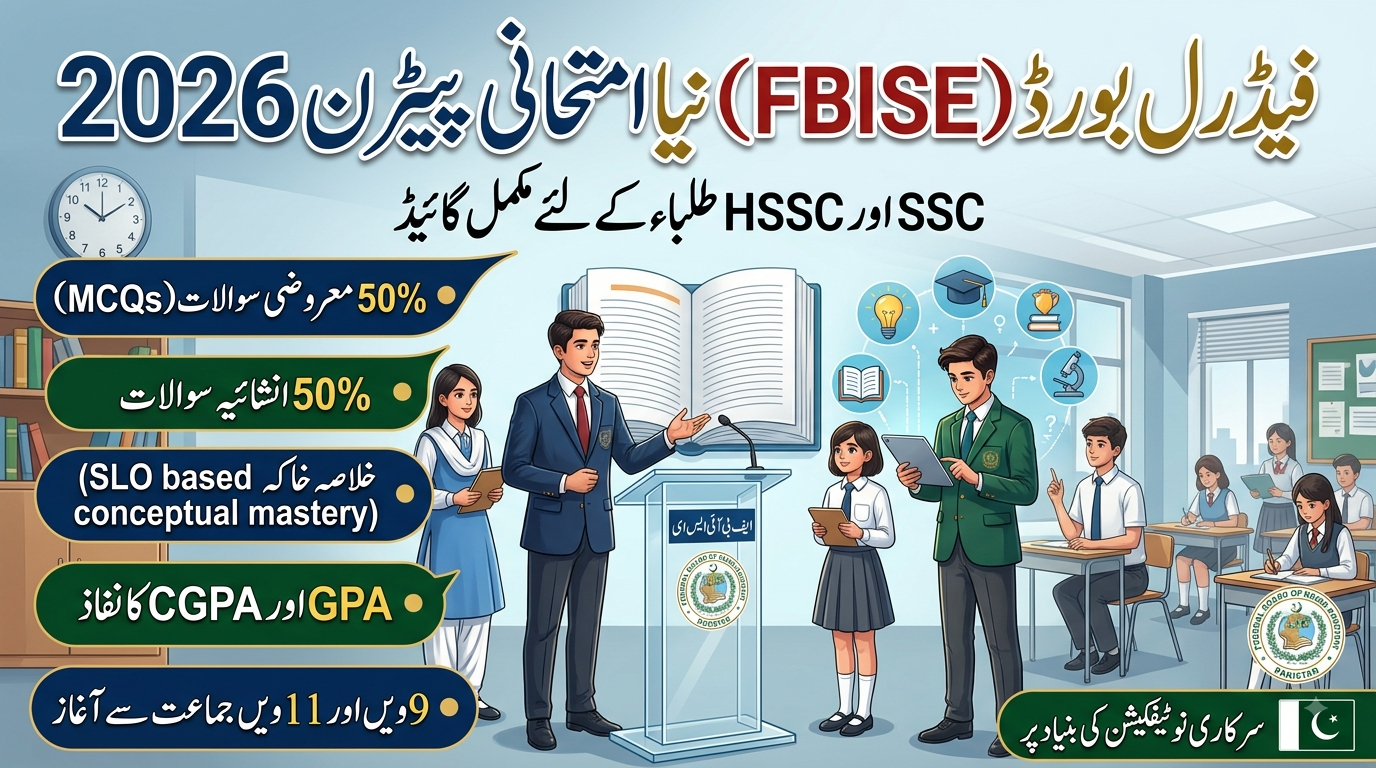
The Federal Board of Intermediate and Secondary Education (FBISE) has officially implemented a major overhaul to its examination pattern and assessment framework for 2026. Designed to align Pakistan’s secondary and higher secondary education with global academic standards, this updated paper scheme shifts the evaluation focus away from traditional rote learning toward Student Learning Outcomes (SLOs), critical reasoning, and practical application.
Key Highlights of the FBISE 2026 Paper Pattern Changes
- 50% Objective (MCQ) Weightage: Objective question papers are expanded to rigorously test analytical comprehension.
- SLO-Based Subjective Sections: Short and long answer questions strictly evaluate conceptual clarity over memorized text.
- Phased Implementation: The rollout applies specifically to 9th (SSC Part-I) and 11th (HSSC Part-I) grade cohorts.
- GPA & CGPA Grading Standard: FBISE continues its transition from raw percentage scoring to a standardized grading system featuring a 40% minimum passing threshold.
Detailed Paper Structure Breakdown
Under the updated scheme, core subjects are structured into two balanced assessment divisions:
| Exam Section | Weightage | Evaluation Focus |
|---|---|---|
| Section A (Objective) | 50% | Multiple Choice Questions (MCQs) designed around real-world scenarios and conceptual basics. |
| Section B & C (Subjective) | 50% | Short Response Questions (SRQs) and Extended Response Questions evaluating analytical skills. |
Note: For science subjects (excluding practicals), theory papers carry 60 marks, while Mathematics theory carries 75 marks.
Core Subjects & Phased Implementation Timeline
5 Main Subjects Covered
- Physics
- Chemistry
- Biology / Computer Science
- Mathematics
- English / Pakistan Studies
Implementation Phasing
- SSC Part-I (9th Class) & HSSC Part-I (11th Class): The new pattern is fully active for the 2026 examination cycle onward.
- SSC Part-II (10th Class) & HSSC Part-II (12th Class): Graduating batches remain under their existing exam schemes to maintain academic continuity.
Effective Preparation Strategies for Students
To score high marks under the new SLO framework, adjust your study habits:
- Eliminate Rote Learning: Avoid memorizing textbook paragraphs word-for-word. Focus on the core mechanics and scientific reasoning behind concepts.
- Practice Official Model Papers: Regularly solve FBISE sample papers and SLO-based question banks to get comfortable with scenario-driven questions.
- Master Chapter-Wise MCQs: Since objective items account for half your overall grade, solve conceptual multiple-choice drills for every chapter.
- Focus on Graphical & Visual Concepts: Practice labeling diagrams, interpreting data charts, and breaking down scientific processes step-by-step.
Official FBISE Government Links for Registration & Model Papers
To access model question papers, register online, or download official curriculum guidelines, visit the official government portals below:
- Official Portal & Online Registration: FBISE Official Website
- Download SLO Model Papers & Question Banks: FBISE Curriculum & Model Papers
- Online Student Services & Roll Number Slips: FBISE Student e-Services Portal
Frequently Asked Questions (FAQs)
Q1: Does the new exam pattern make FBISE board exams harder? Not necessarily. It reduces the stress of memorizing massive amounts of text, making exams more manageable for students who focus on conceptual understanding.
Q2: Will 10th and 12th class students be affected by this pattern in 2026? No. The 50% MCQ and SLO-focused format applies exclusively to entry-tier classes (9th and 11th grades) for this academic session.
Q3: What is the minimum passing mark under the updated FBISE policy? FBISE mandates a minimum pass mark of 40% in individual theory and practical examinations along with the GPA grading framework.
Conclusion
The Federal Board’s updated exam scheme marks a pivotal shift toward modern educational standards in Pakistan. By replacing rote memorization with conceptual comprehension and structured objective assessments, FBISE effectively prepares SSC and HSSC students for future university entrance tests and international academic pursuits. Adapting early to official SLO-based model papers and concept-focused study methods is key to achieving top grades under this modernized system.